SOP Reference: MWS-M01-L8
Lesson 8: Supplemental Feeding Restrictions
Strict prohibition of sucrose and HFCS in pharmaceutical colony management
The Feeding Contamination Pathway
Conventional beekeeping routinely feeds colonies supplemental sugar syrup during nectar dearth periods, for overwintering energy reserves, and to stimulate brood production. Commercial operations commonly use high-fructose corn syrup (HFCS) due to lower cost compared to table sugar. These feeding practices introduce multiple pharmaceutical compliance risks that pharmaceutical honey operations must navigate carefully.
Bees store supplemental feed in the same wax combs where they store nectar-derived honey, creating potential for mixing. Even small quantities of sugar-derived stores dilute botanical markers used for honey authentication. HFCS contains hydroxymethylfurfural (HMF) from processing, potentially elevating HMF in final honey above pharmaceutical limits. Contaminated or mishandled sugar feeds introduce pathogens or chemical residues that compromise honey purity.
The fundamental challenge: colonies occasionally require supplemental nutrition for survival, but pharmaceutical honey cannot contain any non-nectar carbohydrates. This lesson presents protocols that balance colony welfare with pharmaceutical authenticity requirements.
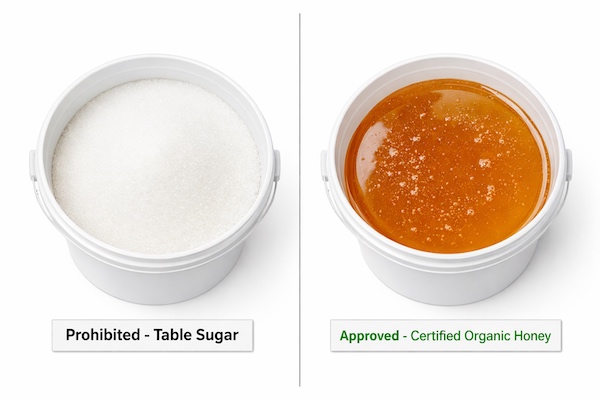
Prohibited Feeding Substances
Table Sugar (Sucrose)
White granulated sugar from sugarcane or sugar beets represents the most common bee feed. While food-grade sugar introduces no chemical contamination, sucrose feeding creates honey authentication problems. Bees metabolize sucrose into glucose and fructose, producing stores indistinguishable from nectar-derived honey by simple sugar analysis. Advanced stable isotope analysis can detect sucrose feeding, but the presence of any non-floral carbohydrates disqualifies honey from pharmaceutical use regardless of detection method.
High-Fructose Corn Syrup (HFCS)
HFCS feeding creates additional problems beyond authentication. Industrial HFCS production involves acid or enzymatic hydrolysis of cornstarch, generating hydroxymethylfurfural (HMF) as a byproduct. Honey with elevated HMF suggests heat damage or age-related degradation, both unacceptable in pharmaceutical applications. HFCS feeding artificially inflates honey HMF levels, creating false indication of quality problems.
Furthermore, HFCS may contain residues from corn production including pesticides, GMO markers, and heavy metals concentrated during processing. These contaminants transfer to honey through bee metabolism and storage.
Protein Supplements and Pollen Substitutes
Commercial pollen substitutes contain soy flour, yeast, and various additives designed to mimic natural pollen nutrition. While these products support brood rearing, they introduce non-natural proteins and potential allergens. Some formulations include antimicrobials or feeding stimulants that leave detectable residues. Pharmaceutical apiaries avoid all commercial pollen substitutes.
| Feed Type | Primary Risk | Pharmaceutical Impact |
|---|---|---|
| Table Sugar (Sucrose) | Authentication compromise | Disqualifies honey as monofloral Manuka |
| High-Fructose Corn Syrup | HMF elevation, pesticide residues | Fails quality parameters, contamination |
| Honey from Non-Certified Sources | Unknown contaminant history | Cannot verify pharmaceutical purity |
| Pollen Substitutes | Additives, antimicrobials | Foreign substance introduction |
| Flavored/Medicated Feeds | Drug residues, artificial compounds | Direct pharmaceutical disqualification |
Approved Emergency Feeding Protocol
The Last Resort Principle
Pharmaceutical apiaries strive to eliminate supplemental feeding through proper site selection ensuring year-round natural forage, maintaining adequate colony honey reserves, and timing management to avoid starvation scenarios. However, extreme weather events, catastrophic forage failure, or unforeseen management errors occasionally create starvation risk requiring emergency intervention.
Certified Organic Honey as Emergency Feed
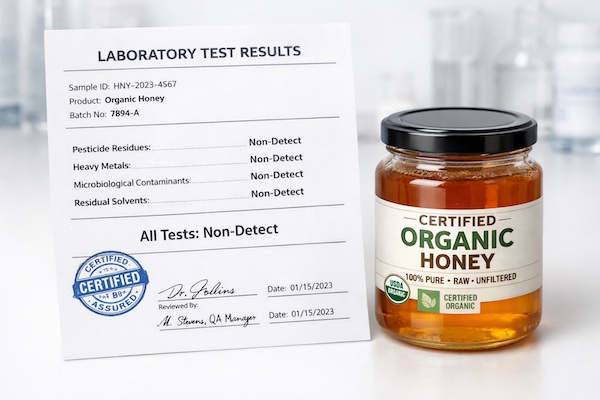
The only approved emergency feed for pharmaceutical colonies is certified organic honey from documented sources with full chemical analysis. This honey must meet all the same purity standards as the pharmaceutical honey being produced, creating a high-cost feeding option that motivates preventing feed-requiring situations.
Feed Honey Qualification Requirements
- Organic Certification: USDA Organic or equivalent certification from recognized certifying body
- Multi-Residue Testing: Laboratory analysis showing non-detect for 400+ pesticide compounds
- Heavy Metal Analysis: Testing for arsenic, lead, cadmium, mercury below action levels
- Antibiotic Screening: Non-detect for common beekeeping antibiotics
- HMF Testing: Hydroxymethylfurfural below 20 mg/kg indicating freshness
- Moisture Content: Below 18% to prevent fermentation during storage
- Chain of Custody: Complete documentation from source apiary through delivery
Feed Honey Sourcing
Most pharmaceutical operations maintain relationships with certified organic apiaries producing food-grade honey. While this honey lacks the MGO content required for pharmaceutical applications, it meets all purity standards for safety. Purchasing in bulk during main-crop season and storing in food-grade containers provides emergency feed reserves at lower cost than urgent procurement.
Emergency Feeding Decision Protocol
Starvation Risk Assessment
Before authorizing supplemental feeding, systematic assessment determines actual starvation risk versus precautionary feeding that compromises pharmaceutical status unnecessarily.
Assessment Criteria
- Honey Store Measurement: Heft test or frame-by-frame assessment quantifies available stores
- Consumption Rate Calculation: Colony size and ambient temperature predict daily consumption
- Forage Availability Forecast: Weather and phenology predict days until nectar flow resumes
- Risk Window Determination: Compare available stores against consumption rate and forage resumption timeline
Decision Matrix
| Days of Stores Remaining | Forage Resumption Timeline | Decision |
|---|---|---|
| More than 14 days | Any timeline | No feeding required, continue monitoring |
| 7-14 days | Forage within 10 days | Intensive monitoring, no feeding |
| 7-14 days | Forage beyond 10 days | Prepare emergency feed, final assessment in 3 days |
| Less than 7 days | Forage uncertain or delayed | Emergency feeding authorized |
Emergency Feeding Execution Protocol
Timing Considerations
Emergency feeding must occur outside honey production windows to prevent feed honey mixing with pharmaceutical honey in active supers. Ideal timing is fall after harvest completion or early spring before nectar flows begin.
Application Method
- Super Removal: Remove all honey supers before feeding, store separately with seals intact
- Frame Placement: Position feed honey frames adjacent to brood nest for immediate accessibility
- Quantity: Provide only calculated minimum needed to bridge gap until natural forage resumes
- Colony Marking: Mark feed-receiving colonies with unique identification
- Exclusion Period: Do not harvest any honey from fed colonies for minimum 60 days post-feeding
- Verification Testing: First harvest after feeding undergoes enhanced authentication testing including stable isotope ratio analysis
Documentation Requirements
- Starvation risk assessment calculations
- Decision rationale and authorization signatures
- Feed honey source and test certificates
- Feeding dates, quantities, and colony identifications
- Post-feeding exclusion period enforcement records
- Verification testing results from first post-feeding harvest
Preventing Feed-Requiring Situations
Site Selection for Year-Round Forage
The primary defense against feeding requirements is site selection ensuring continuous or nearly continuous nectar availability. Sites with extended or multiple bloom periods reduce starvation risk during typical weather patterns.
Adequate Reserve Management
Conservative harvest practices leaving substantial honey reserves in brood chambers provide colony energy reserves through dearth periods. Pharmaceutical operations target minimum 40kg stores per colony entering dormant season.
Conservative Harvest Targets
| Region/Climate | Minimum Overwintering Stores | Harvest Strategy |
|---|---|---|
| Temperate, Cold Winters | 40-50kg per colony | Harvest supers only, never brood chambers |
| Mild Winters, Year-Round Forage | 20-30kg per colony | Conservative super harvest, monitor stores |
| Subtropical, Continuous Brood | 15-20kg minimum | Harvest during flows only, maintain cushion |
Colony Strength Management
Right-sizing colony populations to available forage prevents consumption exceeding production. Fall population reduction through splitting or queen replacement decreases winter consumption while maintaining colony viability.
Protein Nutrition Management
Natural Pollen as Sole Protein Source
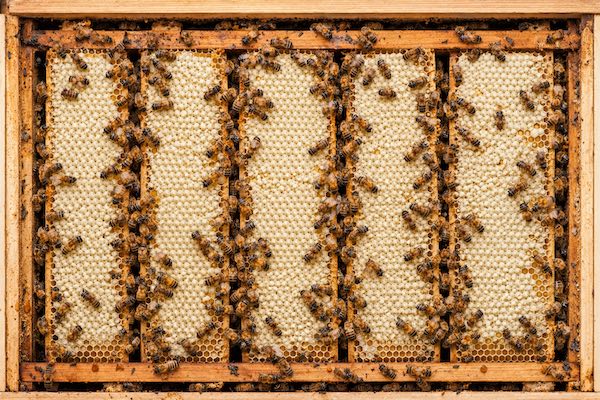
While carbohydrate feeding compromises honey authentication, protein nutrition critically affects colony health and brood production. Pharmaceutical operations rely exclusively on natural pollen from the foraging landscape, prohibiting all artificial pollen supplements and substitutes.
Ensuring Adequate Pollen Availability
Site selection considers pollen availability alongside nectar resources. Ideal pharmaceutical apiary sites provide diverse pollen sources across the active season, preventing protein deficiency that triggers robbing behavior or inappropriate feeding responses.
Pollen Supplementation Alternative
If natural pollen proves inadequate, the only approved intervention involves collecting pollen from certified organic apiaries and feeding as pollen patties. This pollen undergoes same testing regimen as emergency feed honey, ensuring purity before introduction to pharmaceutical colonies.
- Source Verification: Pollen from certified organic apiaries with testing results
- Contamination Testing: Multi-residue pesticide analysis, heavy metals
- Pathogen Screening: Testing for American foulbrood spores and Nosema
- Application Method: Pollen mixed with certified organic honey into patties
- Timing: Feed during non-harvest periods only
Quality Control and Verification
Post-Feeding Honey Authentication
Any honey harvested from colonies receiving emergency feeding undergoes enhanced authentication testing to verify pharmaceutical compliance was maintained.
Enhanced Testing Panel
| Test Parameter | Purpose | Pass Criteria |
|---|---|---|
| Stable Isotope Ratio (C3/C4) | Detect C4 sugar (corn syrup) feeding | C4 content below 7% |
| Sugar Spectrum Analysis | Identify foreign sugar additions | Normal nectar-honey profile |
| Pollen DNA Analysis | Verify Leptospermum source dominance | 70%+ L. scoparium pollen |
| MGO Content | Confirm pharmaceutical-grade activity | Minimum 263 mg/kg (UMF 10+) |
| HMF Content | Rule out feed honey or age effects | Below 40 mg/kg |
Critical Takeaways
- All sugar syrups, HFCS, and pollen substitutes strictly prohibited in pharmaceutical apiaries
- Emergency feeding authorized only for verified starvation risk with documented decision protocol
- Certified organic honey meeting full pharmaceutical purity standards is sole approved emergency feed
- Feeding occurs outside honey production windows with minimum 60-day exclusion before harvest
- Post-feeding honey undergoes enhanced authentication including stable isotope ratio analysis
- Proper site selection and reserve management prevent feeding scenarios