SOP Reference: MWS-M01-L2
Lesson 2: Non-Toxic Hive Construction
Untreated wood and food-grade finishes for pharmaceutical-grade hive equipment
The Hidden Contamination Pathway
Conventional hive construction relies on pressure-treated lumber, exterior-grade plywood, and industrial wood preservatives to extend equipment lifespan under harsh outdoor conditions. These materials contain arsenical compounds, copper-based fungicides, and boron preservatives that slowly leach into the hive environment through temperature cycling and humidity exposure.
Bees contacting treated wood surfaces accumulate these compounds on their bodies and transport them into wax combs during cell construction. Once embedded in the lipid matrix of beeswax, wood preservatives resist removal and concentrate as honey ripens and water evaporates. The final honey product may carry residue levels that fail pharmaceutical toxicity screening despite appearing pristine.
Medical-grade honey production eliminates this pathway by mandating untreated, naturally rot-resistant wood species and restricting all surface treatments to food-grade materials.
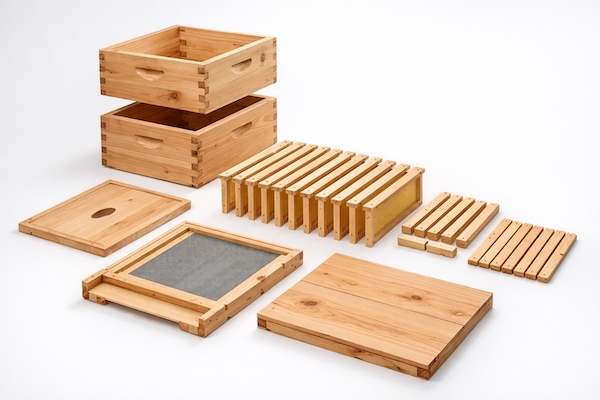
Approved Wood Species
Cedar (Thuja plicata - Western Red Cedar)
Western Red Cedar stands as the gold standard for clinical hive construction due to its natural thujaplicin content, a compound that provides fungal resistance without chemical treatment. The wood machines cleanly, resists warping under moisture cycling, and exhibits natural aromatic compounds that do not transfer to honey at detectable levels.
Specification requirements for medical-grade cedar:
- Heartwood only - no sapwood inclusion allowed
- Kiln-dried to 12-15% moisture content
- Clear grade (free of knots larger than 1/4 inch diameter)
- Vertical grain preferred for dimensional stability
- Sourced from certified sustainable forests with organic management
Cypress (Taxodium distichum - Bald Cypress)
Bald cypress contains cypressene, a natural preservative that rivals cedar in rot resistance. Old-growth cypress, though increasingly scarce, provides exceptional longevity. Plantation-grown cypress from organic forestry operations offers a sustainable alternative with comparable performance.
Cypress advantages include superior dimensional stability in high-humidity environments and natural resistance to insect damage. The wood's density provides better thermal mass for hive temperature regulation.
White Pine (Pinus strobus) - Conditional Approval
White pine qualifies for interior hive components only. While lacking natural rot resistance, its workability and availability make it suitable for frames and internal structures that receive weather protection from exterior boxes. White pine must undergo accelerated aging protocol to release volatile terpenoids before colony installation.
| Component | Primary Species | Alternative | Service Life |
|---|---|---|---|
| Hive Bodies | Western Red Cedar | Bald Cypress | 15-20 years |
| Bottom Boards | Western Red Cedar | Bald Cypress | 10-15 years |
| Covers | Cedar Heartwood | Cypress | 20+ years |
| Frames | White Pine | Cedar | 8-10 years |
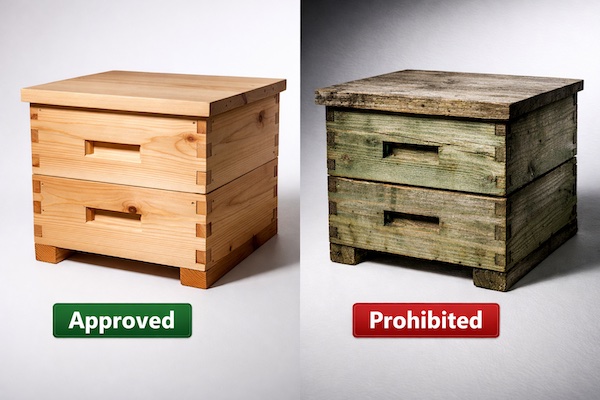
Prohibited Materials and Treatments
Pressure-Treated Lumber
All chromated copper arsenate (CCA), alkaline copper quaternary (ACQ), and micronized copper azole (MCA) treated materials are categorically prohibited. These preservative systems leach heavy metals and biocides that accumulate in hive matrices and concentrate in honey during water evaporation.
Plywood and Composite Materials
Exterior-grade plywood contains phenol-formaldehyde adhesives that off-gas formaldehyde vapor into the hive atmosphere. Oriented strand board (OSB) and medium-density fiberboard (MDF) similarly release urea-formaldehyde. These compounds not only contaminate honey but also affect colony health through chronic low-level exposure.
Paint and Conventional Stains
Oil-based paints contain petroleum distillates, heavy metal driers, and volatile organic solvents. Latex paints, despite being water-based, include acrylate monomers and antimicrobial agents that leach under solar heating. Conventional wood stains contain coal-tar derivatives and aromatic hydrocarbon solvents.
Commercial Wood Preservatives
| Preservative Type | Active Ingredients | Contamination Risk |
|---|---|---|
| Copper-Based | Copper compounds, quaternary ammonium | Heavy metal accumulation in wax |
| Boron Preservatives | Boric acid, borax | Bee toxicity, honey contamination |
| Creosote | Coal tar distillates, PAHs | Carcinogenic residues in honey |
| Pentachlorophenol | Chlorinated phenols | Persistent organic pollutant |
Food-Grade Surface Treatments
The Need for Protection
Untreated wood, while eliminating contamination risk, remains vulnerable to accelerated degradation in outdoor service. Water absorption drives dimensional changes that open joints and compromise structural integrity. Fungal colonization degrades wood fiber and reduces service life. Food-grade surface treatments provide weather protection while maintaining pharmaceutical compliance.
Approved Coating Systems
Raw Linseed Oil (Organic)
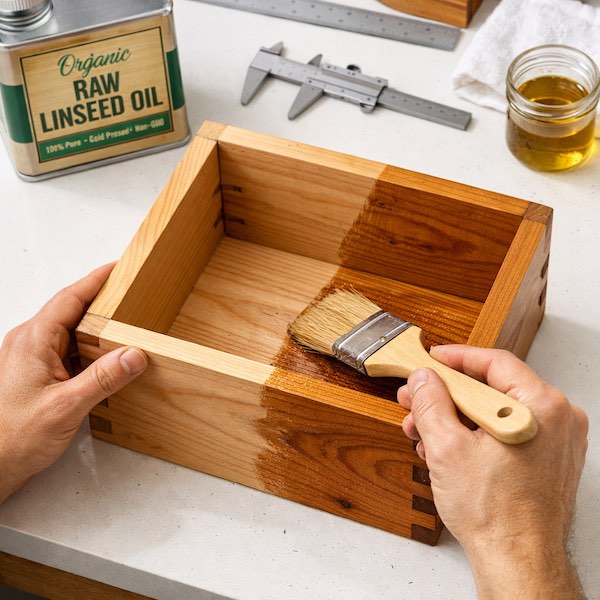
Cold-pressed, unboiled linseed oil from organic flax provides water resistance through polymerization into a durable film. The treatment requires multiple coats with complete absorption between applications. Initial application involves flooding the wood surface, allowing 30-minute penetration, then wiping excess. Subsequent coats follow 48-hour intervals until the wood refuses additional oil absorption.
Curing requires 30 days minimum before colony installation to allow complete polymerization of fatty acid chains. Properly cured linseed oil creates a non-toxic barrier that will not leach or transfer to hive products.
Beeswax-Based Sealant
Pharmaceutical-grade beeswax combined with organic jojoba oil (60:40 ratio) creates a moisture barrier compatible with honey production. The mixture heats to 85 degrees Celsius for homogenization, then applies via brush to warmed wood surfaces. Multiple thin coats outperform single thick applications.
This treatment method offers the advantage of sourcing from the apiary's own production once a pharmaceutical-grade batch has been certified. The resulting surface finish feeds existing hive wax rather than introducing foreign substances.
Tung Oil (Pure, Organic)
Pure tung oil from organic Aleurites fordii cultivation provides superior water resistance compared to linseed oil. The oil polymerizes upon oxygen exposure to form a flexible, protective coating. Tung oil requires thinner application coats but achieves full cure in 14 days under optimal conditions.
Verification of purity is critical. Commercial "tung oil" products often contain petroleum distillate thinners and synthetic driers. Only 100% pure tung oil from certified organic sources qualifies for pharmaceutical applications.
Construction Protocols
Joinery Standards
Mechanical fasteners must be stainless steel to prevent rust contamination. Box joints provide maximum glue surface area for structural integrity without requiring toxic adhesives. All joints receive pharmaceutical-grade polyvinyl acetate (PVA) wood glue that cures into an inert polymer matrix.
Assembly Sequence
- Material Acclimation: Wood components equilibrate to assembly environment humidity for 7 days before construction. This prevents joint failure from post-assembly dimensional changes.
- Dry Fit Assembly: All components undergo dry assembly without glue to verify joint fit and alignment. Any modifications occur before glue application.
- Glue Application: PVA glue applies to both mating surfaces in thin, even coats. Excess glue removal occurs immediately with damp cloth before cure initiates.
- Clamping: Stainless steel bar clamps apply even pressure across joint surfaces. Clamp pressure maintains contact without causing glue squeeze-out or wood crushing.
- Cure Time: Glue cures 24 hours minimum before clamp removal. Full strength develops over 7 days.
- Surface Treatment: After cure completion, surface treatment (linseed oil, beeswax, or tung oil) applies per the protocols detailed in Section 4.
- Final Cure: Completed hive components cure an additional 30 days in ambient conditions before receiving colonies.
Frame Construction Specifics
Wooden frames receive white pine or cedar components assembled with stainless steel nails or screws. Frame foundation utilizes either foundation-less design or certified organic beeswax foundation sheets. Plastic foundation of any type is prohibited due to polymer leaching and microplastic contamination risk.
Quality Control and Testing
Pre-Production Material Verification
All lumber undergoes independent laboratory testing for heavy metals, pesticide residues, and volatile organic compound content before acceptance into production. Batch sampling occurs at 10% rate with composite samples representing each delivery lot.
Test parameters include:
- Heavy metals panel: Arsenic, lead, copper, chromium (detection limit 0.1 ppm)
- Pesticide residue screen: 400+ compound multi-residue method
- VOC analysis: Formaldehyde, benzene, toluene (headspace GC-MS)
- Moisture content verification: Target 12-15% by dry weight
Finished Component Testing
After construction and surface treatment cure, random samples of completed hive components undergo leachate testing. Components submerge in distilled water at 40 degrees Celsius for 72 hours, simulating worst-case humidity exposure. The resulting leachate undergoes analysis for the same contamination panels used in raw material testing.
Acceptance criteria require all analytes to remain below detection limits. Any detectable contamination triggers batch rejection and root cause investigation.
Service Life and Replacement Criteria
Monitoring Equipment Degradation
Untreated wood hive components, even with food-grade surface protection, experience gradual degradation through moisture cycling, solar UV exposure, and mechanical stress from hive manipulation. Service life varies based on climate, maintenance, and usage intensity.
Replacement Indicators
- Structural Compromise: Cracked corners, separated joints, or visible delamination mandate immediate replacement
- Surface Degradation: Loss of surface treatment with exposed bare wood indicates need for re-treatment or replacement
- Fungal Growth: Any visible mold, mildew, or fungal fruiting bodies trigger component retirement
- Dimensional Distortion: Warping, cupping, or twisting that prevents proper stacking requires replacement
- Age Limits: Maximum service life of 20 years for exterior components, 15 years for interior components regardless of apparent condition
Retirement Protocol
Retired hive components do not transfer to conventional apiaries or repurpose for non-pharmaceutical production. Contamination risk from pharmaceutical-grade operations could compromise conventional operations through cross-contamination. Retired components undergo controlled disposal or repurposing for non-apiary applications.
Critical Takeaways
- Only untreated heartwood from cedar, cypress, or pine qualifies for hive construction
- All pressure-treated lumber, plywood, and composite materials are prohibited
- Surface treatments must be food-grade: organic linseed oil, beeswax sealant, or pure tung oil
- Raw material testing verifies absence of heavy metals, pesticides, and VOCs
- 30-day cure period required before colony installation
- Service life limits prevent accumulation of degradation-related contamination