SOP Reference: MWS-M01-L6
Lesson 6: Water Source Purity
Filtered vs stagnant water management for colony health and contamination control
Water as a Contamination Vector
Honeybee colonies consume substantial water volumes for thermoregulation, honey dilution, and larval food preparation. A strong colony during active season requires 200-500 liters of water annually. Worker bees collect this water from environmental sources within their foraging range, creating a direct pathway for contaminant introduction into the hive.
Unlike nectar collection where bees show strong floral preferences, water foraging exhibits less discrimination. Bees readily collect from stagnant pools, agricultural runoff, livestock watering sites, and sewage treatment facilities if these represent the nearest available water. Each water source carries its own contamination signature: pesticides from agricultural runoff, heavy metals from industrial discharge, pharmaceuticals from wastewater, and pathogens from stagnant conditions.
Pharmaceutical honey operations eliminate this variable contamination risk by providing controlled, tested water sources within the apiary perimeter. Bees preferentially use the closest water source to minimize flight distance, making strategically placed clean water stations effective intervention tools.
Water Quality Standards
Pharmaceutical-Grade Water Specifications
Water provided to pharmaceutical apiaries must meet or exceed drinking water standards, with additional restrictions on agricultural chemicals not typically monitored in municipal supplies.
| Parameter | Maximum Acceptable Level | Testing Frequency |
|---|---|---|
| Coliform Bacteria | Non-detect per 100ml | Monthly |
| Heavy Metals (As, Pb, Cd, Hg) | EPA drinking water limits | Quarterly |
| Pesticide Multi-Residue | Non-detect (LOQ 0.01 ppb) | Monthly during active season |
| Nitrate-Nitrogen | Below 10 mg/L | Monthly |
| Total Dissolved Solids | Below 500 mg/L | Quarterly |
| pH | 6.5-8.5 | Weekly |
Source Water Options
Multiple water sources can meet pharmaceutical standards depending on local hydrogeology and contamination risk profiles.
- Deep Well Water: Groundwater from confined aquifers below agricultural influence zones typically shows low contamination. Requires testing to verify absence of naturally occurring arsenic or fluoride.
- Municipal Water Supply: Treated public water meets base standards but may contain chlorine, chloramines, or fluoride requiring additional treatment.
- Spring Water: Natural springs from protected watersheds can provide pharmaceutical-grade water but require comprehensive testing to verify purity.
- Rainwater: Properly collected rainwater from uncontaminated catchment surfaces offers high purity but needs storage protocol to prevent microbial growth.
Water Station Design and Construction
Container Material Standards
Water storage and presentation containers must use food-grade materials that resist leaching and support cleaning protocols. Pharmaceutical operations prohibit galvanized metal containers due to zinc leaching, and reject plastic containers not certified BPA-free and food-safe.
Approved Container Materials
| Material | Advantages | Limitations | Recommended Use |
|---|---|---|---|
| Stainless Steel (304/316) | Inert, durable, autoclavable | Expensive, heat absorption | Presentation basins |
| Food-Grade HDPE | Lightweight, UV resistant | Potential leaching if degraded | Bulk storage |
| Glass | Completely inert | Fragile, impractical for field | Laboratory testing samples |
| Ceramic (Glazed) | Inert, temperature stable | Heavy, breakable | Presentation basins (decorative) |
Landing Surface Design
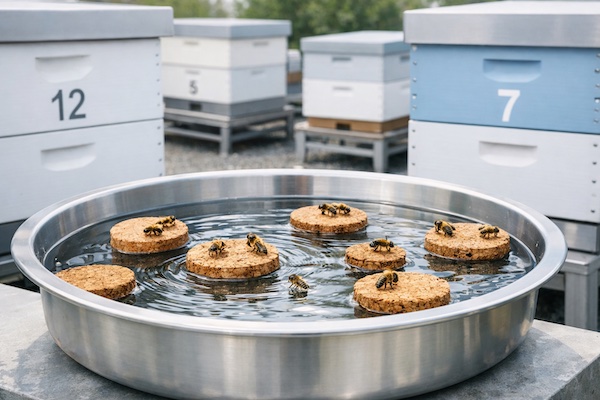
Bees drown easily in open water. Successful water stations provide landing platforms that allow bees to access water while maintaining secure footing. Multiple approaches work effectively:
- Cork Floats: Natural cork pieces float on water surface, providing stable landing platforms. Replace monthly to prevent mold growth.
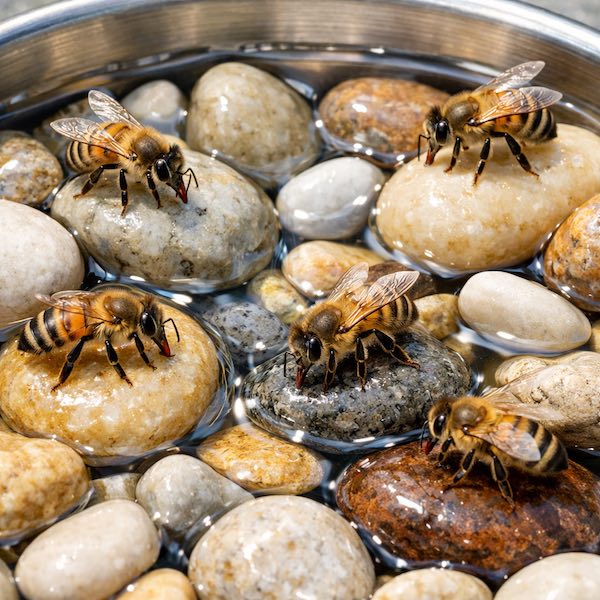
- Pebble Substrate: Shallow basins filled with cleaned river rock allow water to pool between stones at bee-accessible depth.
- Mesh Platforms: Stainless steel mesh suspended just above water surface provides landing area while allowing water access.
- Sloped Access: Gradually sloped basins allow bees to walk into shallow edges while deep center maintains volume.
Water Treatment Systems
Filtration Requirements
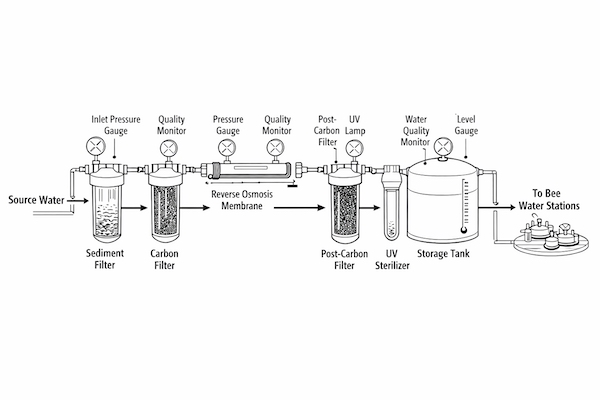
Source water requiring treatment to meet pharmaceutical standards undergoes multi-stage filtration designed to remove particulates, dissolved contaminants, and microorganisms without introducing treatment chemicals.
Treatment Train Components
- Sediment Pre-Filter: 5-micron cartridge filter removes suspended particles, extending life of downstream filters
- Carbon Block Filter: Activated carbon removes chlorine, chloramines, volatile organic compounds, and some pesticides
- Reverse Osmosis: Semi-permeable membrane removes dissolved salts, heavy metals, nitrates, and remaining organic contaminants
- Post-Carbon Polish: Final carbon stage removes any residual tastes or odors from RO membrane
- UV Sterilization: Ultraviolet exposure at 254nm wavelength inactivates bacteria and viruses without chemical addition
Alternative Treatment: Distillation
Water distillation provides pharmaceutical-grade purity through vaporization and condensation. Dissolved minerals and most contaminants remain in the boiling chamber while pure water vapor condenses into collection vessel. Distillation removes virtually all contaminants but requires significant energy input and produces water more pure than necessary for bee use. Reserve distillation for situations where filtration cannot achieve required purity.
Station Placement Strategy
Proximity Principles
Bees exhibit strong preference for closest available water sources. Strategic station placement within the apiary perimeter reduces probability of bees seeking alternative water sources in surrounding landscape.
Optimal Placement Guidelines
- Distance from Hives: 20-50 meters provides convenient access without encouraging hive entrance loitering
- Sun Exposure: Partial shade prevents excessive heating while morning sun encourages early season use
- Wind Protection: Sheltered locations reduce water loss to evaporation and provide calm landing conditions
- Elevation: Ground-level or slightly elevated positions accessible without significant flight effort
- Multiple Stations: For apiaries exceeding 20 hives, distribute stations at 50-meter intervals to prevent crowding
Competitive Exclusion of Natural Sources
Provided water stations must outcompete any natural water sources within bee flight range. Early season establishment, before natural water becomes accessible, habituates colonies to artificial stations. Maintaining stations year-round prevents bees from discovering alternative sources during temporary station failures.
Maintenance and Sanitation Protocols
Daily Maintenance
Water stations require daily attention during active season to maintain quality and prevent disease transmission between colonies.
- Water Level Check: Verify adequate water volume, refill as needed
- Landing Surface Inspection: Ensure floats or platforms remain functional, replace degraded materials
- Drowning Retrieval: Remove any drowned bees to prevent decomposition and water fouling
- Temperature Monitoring: During hot weather, replace water if temperature exceeds 30°C
Weekly Sanitation
Complete cleaning and disinfection occurs weekly during active season, bi-weekly during cool periods with reduced bee activity.
- Complete Drain: Remove all water and surface materials from container
- Mechanical Cleaning: Scrub interior surfaces with dedicated brush to remove biofilm
- Sanitizer Application: Treat with food-grade sanitizer (hydrogen peroxide 3% solution, 10-minute contact time)
- Thorough Rinse: Triple rinse with clean water to remove all sanitizer residue
- Air Dry: Allow complete drying before refilling
- Landing Surface Cleaning: Cork floats and platforms undergo same cleaning protocol
Equipment Replacement Schedule
| Component | Replacement Frequency | Reason |
|---|---|---|
| Cork Floats | Monthly | Mold growth, saturation |
| Sediment Filters | 3 months or pressure drop | Particulate loading |
| Carbon Filters | 6 months | Adsorption capacity exhaustion |
| RO Membranes | 2-3 years | Membrane fouling, reduced rejection |
| UV Lamps | Annually | UV intensity degradation |
Seasonal Management Adjustments
Early Spring Preparation
Bees begin foraging for water before nectar flows commence, using water for brood rearing and hive humidity regulation. Early establishment of water stations during this period imprints colony foraging patterns before bees discover alternative sources.
Spring Protocol
- Stations operational two weeks before first bee flights
- Water temperature warmed to 20-25°C to encourage early adoption
- Extra stations deployed temporarily to maximize colony contact
- Landing surfaces abundant to accommodate heavy traffic
Summer Heat Management
Peak summer temperatures drive maximum water consumption for evaporative cooling. Colonies increase water foraging tenfold during heat stress periods.
Hot Weather Modifications
- Water replacement twice daily to maintain cool temperatures
- Station capacity doubled to prevent depletion
- Additional shade structures deployed to reduce solar heating
- Ice blocks floated in bulk storage to reduce temperature
Fall and Winter Operations
Reduced colony activity decreases water demand but cold-period access remains important for periodic cleansing flights and cluster humidity management.
Cold Season Protocol
- Station volume reduced to prevent waste and freezing risk
- Heating elements maintain liquid water in freezing conditions
- Stations positioned in south-facing locations for solar warming
- Maintenance frequency reduced to weekly inspection
Contamination Event Response
Detection of Water Contamination
Routine water testing occasionally reveals contamination in station water. Sources include filter breakthrough, storage container degradation, or external contamination from aerial deposition or wildlife.
Immediate Response Protocol
- Station Isolation: Immediately remove contaminated stations from service
- Alternate Water Provision: Deploy emergency clean water stations at different locations
- Investigation: Trace contamination source through systematic testing of treatment system components
- System Decontamination: Complete cleaning and sanitization of affected equipment
- Verification Testing: Test new water samples before returning system to service
- Documentation: Record incident details, analytical results, and corrective actions
Honey Impact Assessment
Contamination detected in water stations may indicate honey contamination risk if bees transported contaminants into hive before detection. Honey batches from affected period undergo intensified testing before release for pharmaceutical use.
Alternative Water Sources: Risk Assessment
Natural Water Bodies Within Foraging Range
Even with excellent water station management, bees may occasionally visit natural water sources. Risk assessment of these sources informs contamination probability and testing priorities.
| Water Source Type | Primary Contamination Risk | Management Strategy |
|---|---|---|
| Agricultural Ponds | Pesticide runoff, fertilizer nutrients | Prevent through superior station placement |
| Livestock Watering | Fecal bacteria, pharmaceuticals | Secure competitive exclusion through proximity |
| Stagnant Pools | Pathogens, heavy metals | Drainage if within controlled property |
| Industrial Discharge | Heavy metals, chemical contaminants | Site relocation if within 3km radius |
Documentation and Record Keeping
Required Water Quality Records
Pharmaceutical compliance mandates comprehensive documentation of water source, treatment, testing, and delivery to colonies.
Documentation Components
- Source water test results (all parameters, all dates)
- Treatment system maintenance logs
- Filter replacement records with batch numbers
- Daily station maintenance checklists
- Weekly cleaning and sanitation records
- Contamination events and response actions
- Water consumption estimates by colony count
- Seasonal management adjustments and rationale
These records integrate with overall pharmaceutical honey chain-of-custody documentation, demonstrating due diligence in contamination prevention through controlled water sources.
Critical Takeaways
- Colonies require 200-500 liters of water annually, creating direct contamination pathway
- Provided water must meet drinking water standards plus pharmaceutical-specific restrictions
- Multi-stage filtration (sediment, carbon, RO, UV) achieves pharmaceutical purity
- Strategic station placement within 20-50 meters of hives competes successfully with natural sources
- Daily maintenance and weekly sanitation prevent disease transmission
- Comprehensive documentation demonstrates contamination control due diligence