Live Sanctuary Environmental Monitoring
Our research is backed by real-time data. See how current humidity and wind speeds are affecting foraging and honey drying in our sanctuaries today.
Field Data Sync: Active • Sanctuary GPS: Verified • Series: 2023–2026
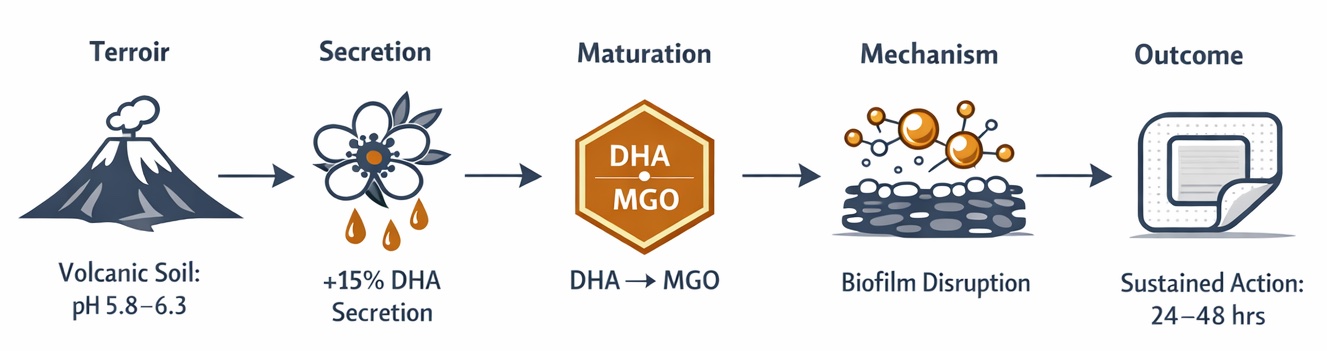
Research pathway: Environmental stress factors directly influence therapeutic MGO concentrations from soil chemistry to clinical wound bed.
Our 12 research sanctuaries across New Zealand form a controlled observation network spanning volcanic plateaus, coastal lowlands, and alpine foothills. The environmental data collected at each site guides clinical product sourcing and helps wound care professionals trace MGO potency back to specific geographic conditions.
| Sanctuary Location | Elevation | Soil Type | Climate Profile | MGO Level (mg/kg) | Clinical Grade |
|---|---|---|---|---|---|
| Coromandel Peninsula | 340m | Volcanic acidic | Maritime temperate | 850+ | Premium |
| Rotorua Volcanic | 380m | Pumice volcanic | High thermal stress | 790 | Premium |
| Far North Sanctuary | 120m | Sandy volcanic | Subtropical coastal | 780 | Premium |
| East Cape Sanctuary | 160m | Coastal sediment | Exposed maritime | 760 | Premium |
| Canterbury Foothills | 420m | Alpine loess | Cold diurnal variation | 730 | Premium |
| Northland Sanctuary | 200m | Clay-rich volcanic | Humid subtropical | 720 | Premium |
| Marlborough Sounds | 150m | Schist-greywacke | Sheltered maritime | 710 | Premium |
| Manawatu Ranges | 280m | Mudstone hills | Wet temperate | 700 | Standard |
| Waikato Hill Country | 220m | Sedimentary clay | Mild temperate | 680 | Standard |
| Hauraki Plains | 80m | Alluvial sediment | Temperate maritime | 650 | Standard |
| West Coast Sanctuary | 90m | River gravel | High rainfall | 640 | Standard |
| Hawke's Bay | 100m | Limestone alluvial | Mediterranean-like | 620 | Standard |
Clinical Interpretation: Premium grade (700+ mg/kg) recommended for biofilm-disruption protocols and MRSA-positive wounds. Standard grade (600-699 mg/kg) suitable for routine wound maintenance and superficial injuries.
Just as fine wine is shaped by the vineyard's soil, the potency of Manuka honey depends directly on its environmental terroir. Our sanctuary research identifies the specific geographic and climatic variables that trigger the Leptospermum scoparium (Manuka bush) to produce higher concentrations of DHA, which converts to the active antimicrobial compound Methylglyoxal (MGO).
By protecting these micro-climates from agricultural drift and industrial pollutants, we maintain a clean production chain essential for medical-grade applications. Our data shows that hives in high-altitude, high-stress environments often produce significantly more potent bioactives as a natural defense mechanism of the plant.
Our research is backed by real-time data. See how current humidity and wind speeds are affecting foraging and honey drying in our sanctuaries today.
Our ongoing mapping project analyzes the correlation between environmental stress and bioactive yield. We track three primary data points across our sanctuary network:
We have observed that volcanic soils with high mineral content correlate with a 15% increase in DHA secretion in the Manuka flower.
High diurnal temperature swings (hot days and cold nights) appear to trigger a metabolic "potency spike" in high-altitude sanctuaries.
Our sensors track hive-internal humidity. Lower ambient humidity allows bees to reduce honey water content faster, naturally concentrating MGO.
Higher mineral content from volcanic soils correlates with enhanced antimicrobial persistence in wound beds. The DHA-to-MGO conversion continues in the wound environment, providing sustained therapeutic action over 24-48 hours.
Potency spikes from thermal stress mean more reliable MGO consistency batch-to-batch. This reduces dosing variability in clinical protocols and ensures predictable antimicrobial efficacy.
Natural concentration through atmospheric curing preserves the live enzyme profile, including glucose oxidase responsible for slow-release hydrogen peroxide. This creates a multi-layered antimicrobial defense when applied to wounds.
Comparative analysis of soil pH, thermal stress index, and humidity across three representative sanctuary types.
Protection of the land is not just an ethical choice; it is a clinical necessity. Our sanctuaries employ Low-Intervention Beekeeping, ensuring that colonies are never over-harvested or exposed to synthetic miticides. We monitor hive internal temperatures and humidity via remote sensors to ensure the bees are thriving in optimal conditions.
This stewardship ensures that the enzymes within the honey, such as glucose oxidase, remain intact. These enzymes work in tandem with MGO to provide a multi-layered antimicrobial defense critical for clinical wound management.
Our sanctuary data identifies four primary potency tiers. Use this guide to match the observed environmental profile of your honey source to the appropriate clinical or consumer application.
Step 1: What is the primary application?
The following products are cited in our field notes because they meet the minimum MGO verification standards documented in our sanctuary data. All items carry third-party MGO testing documentation. These are consumer-grade products. For medical wound care, consult a licensed clinician.
| MGO Tier | Sanctuary Correlation | Verified Source | Clinical Grade Match | Field Notes Link |
|---|---|---|---|---|
| MGO 1600+ | Rotorua Volcanic / Coromandel peak sites | Manuka Health Pinnacle Harvest MGO 1600+ | Premium | View Data |
| MGO 1100+ | High-altitude thermal stress sites | Wedderspoon Raw Monofloral MGO 1100+ | Premium | View Data |
| MGO 1000+ | Far North Sanctuary / Waikato Hill sites | Manuka Health Reserve MGO 1000+ | Premium | View Data |
| MGO 856+ | Single-origin terroir match | Manuka Health Single Origin Pohuenui MGO 856+ | Premium | View Data |
| MGO 850+ | Coromandel Peninsula baseline | Wedderspoon Raw Manuka MGO 850+ | Premium | View Data |
| MGO 800+ | Northland coastal high-humidity sites | Manuka Health Ultra MGO 800+ | Premium | View Data |
| MGO 600+ | Mid-altitude temperate sites | Manuka Health Extra MGO 600+ | Standard | View Data |
| MGO 600+ Kit | Multi-site blended sample | Manuka Health MGO 600+ Kit | Standard | View Data |
| MGO 400+ | Valley floor lowland sites | Wedderspoon Raw Monofloral MGO 400+ | Standard | View Data |
| MGO 400+ | Valley floor baseline | Manuka Health Daily MGO 400+ | Standard | View Data |
| MGO 300+ | Entry-grade lowland harvest | Manuka Health Classic MGO 300+ | Consumer | View Data |
| MGO 150+ | Coastal entry-grade sites | Wedderspoon Monofloral MGO 150+ | Consumer | View Data |
| MGO 50+ | Multifloral foraging range | Wedderspoon Raw Multifloral MGO 50+ | Consumer | View Data |
| All listed products carry independent third-party MGO laboratory certification. Pricing and availability vary. Our field observation data is not a guarantee of individual product potency. | ||||
Stop guessing and start trusting the data. Jordan and Quinn explain how the Hive Ops Center analyzes local conditions to tell you exactly when your bees are safe to fly, when they are successfully making honey, and when it is best to leave the hive undisturbed. We break down the physics of forage thresholds, the "honey burn" of flight, and how to protect your brood by knowing when to keep the lid on.
Products from Wedderspoon Organic and Manuka Health New Zealand. Food-grade consumer products. Affiliate disclosure.