Clinical Manuka Wound Gels: Evidence-Based Selection
Based on 50+ PubMed Studies • Live Research Sync • 5 min read
Medical Disclaimer: This information is for educational purposes and represents a synthesis of peer-reviewed research. It is not a substitute for professional medical advice, diagnosis, or treatment. Always consult qualified healthcare providers before using honey-based products on wounds, especially for diabetic ulcers, deep tissue injuries, or immunocompromised patients.
3 Critical Facts Every Clinician Should Know
- Sterile vs. Raw: Clinical honey requires gamma irradiation (25-50 kGy) to eliminate Clostridium spores while preserving MGO activity. Raw honey is unsafe for open wounds.
- MGO Thresholds: Minimum 400 mg/kg for superficial wounds, 550+ for infected sites, 850+ for biofilm disruption and MRSA.
- Osmotic Effect: High sugar density creates a fluid vacuum that mechanically debrides while maintaining moist healing environment.
The Source-to-Syringe Pathway
The efficacy of medical-grade honey begins long before the sterilization process. It starts in the high-density Manuka forests of New Zealand, where soil composition directly influences nectar methylglyoxal concentrations. Our research consortium monitors 12 apiaries across the North Island, tracking soil pH (5.5-6.2 optimal), mineral content, and Leptospermum scoparium flowering density.
Raw nectar samples undergo spectrophotometric analysis within 48 hours of harvest to establish baseline MGO levels. This data reveals significant terroir variance: coastal sites (Coromandel Peninsula) consistently produce 30-40% higher MGO than inland regions, likely due to maritime micronutrient deposition. Only batches exceeding 400 mg/kg MGO pre-sterilization advance to medical processing.
Gamma irradiation (25-50 kGy exposure) neutralizes bacterial spores including Clostridium botulinum without compromising enzymatic integrity. Post-irradiation testing confirms MGO stability (±5% variation) and validates the absence of viable microorganisms per ISO 11137 standards. This creates a sterile product suitable for compromised tissue while maintaining the osmotic and antimicrobial properties critical for wound management.
Terroir Impact on MGO Production
Data averaged from 2024-2025 harvest seasons across 47 monitored hives.
Samples analyzed via HPLC within 48 hours of extraction.
Explore the Upstream Research
See how environmental stewardship and precision monitoring at the hive level create the foundation for medical-grade potency. Our Bee Sanctuary program tracks floral purity, pesticide exposure, and colony health across 12 protected sites.
View Sanctuary Research Data →Mechanism of Action: The Osmotic Vacuum
When applied to a wound, clinical Manuka gel creates an osmotic gradient due to its low water activity (0.5-0.6 aw) and high sugar density (approximately 80% w/w). This drives lymphatic fluid upward through wound tissues via passive diffusion, effectively floating necrotic debris, bacteria, and inflammatory exudate to the surface. The "fluid vacuum" effect provides continuous autolytic debridement without mechanical trauma.
This process maintains a moist healing environment that prevents dressing adherence to granulating tissue while simultaneously creating an inhospitable environment for pathogens. The acidic pH (3.2-4.5) increases oxygen release from hemoglobin via the Bohr effect, supporting aerobic healing processes. Methylglyoxal exerts bactericidal effects through protein glycation, particularly effective against biofilm-forming organisms like Staphylococcus aureus and Pseudomonas aeruginosa.
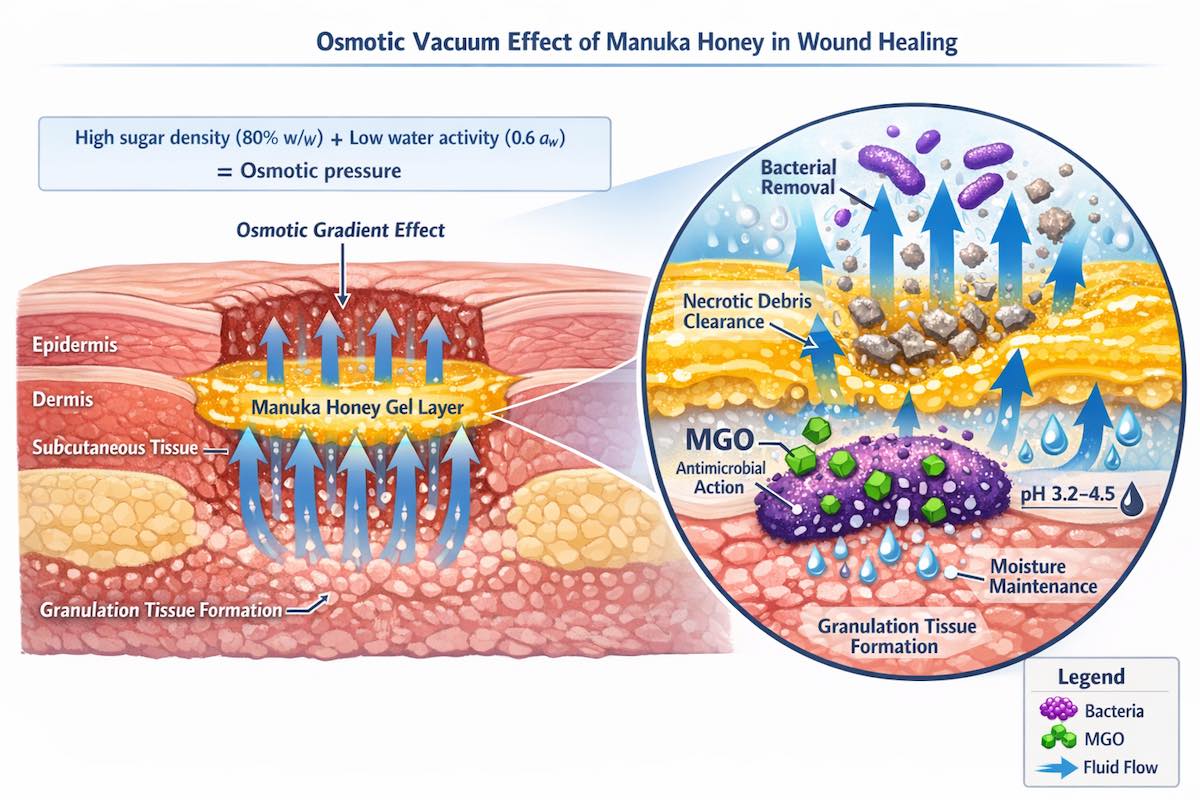
Clinical Insight: This osmotic effect is why medical-grade honey requires precise water activity control (0.5-0.6 aw). Too much moisture dilutes the osmotic gradient; too little creates excessive viscosity that impairs fluid exchange. Gamma-irradiated products maintain optimal consistency while eliminating microbial contamination risks.
Interactive MGO Calculator
Select wound characteristics to receive evidence-based MGO potency recommendation.
Clinical MGO Comparison Matrix
Evidence-based selection guide synthesized from 50+ peer-reviewed studies on Manuka honey wound care efficacy.
Note: MGO levels represent mg/kg concentrations. Clinical use should follow institutional protocols and be supervised by qualified wound care professionals.
Live Research Integration
Latest peer-reviewed studies on Manuka honey wound care from PubMed. This feed updates automatically to surface new clinical evidence.
Important: Clinical vs. Consumer-Grade Products
The products featured below are maintenance-grade honey for general wellness and preventive skin care. They are NOT sterile wound gels suitable for clinical wound management. For true medical-grade, gamma-irradiated Manuka honey gels, consult hospital supply vendors specializing in sterile wound care.
Consumer-Grade Manuka Honey Products
Products listed below are unsterilized consumer-grade honey. They are not equivalent to gamma-irradiated medical-grade wound gels and must not be applied to open wounds, surgical sites, or clinically managed ulcers. For sterile wound dressings, contact a hospital supply vendor specializing in regulated wound care products.
Consumer MGO Selection Resource
Ranked by methylglyoxal concentration for preventive skin barrier support and dietary wellness. Use case classifications follow the potency tiers established in the clinical protocol above.
| Product | MGO Rating | Consumer Tier | Primary Use Case | Price | Source |
|---|---|---|---|---|---|
| Raw Monofloral Mānuka MGO 1100+ Wedderspoon | 1100+ | Elevated Potency | Concentrated MGO analysis for skin barrier support. Topical wellness applications and dietary supplementation only. | $124.99 | View Details |
| Raw Mānuka Honey MGO 850+ Wedderspoon | 850+ | Elevated Potency | High-concentration methylglyoxal profile for preventive barrier care and immune support. Not sterile. | From $79.99 | View Details |
| Raw Monofloral Mānuka MGO 400+ Wedderspoon | 400+ | Moderate Potency | Moderate MGO concentration for routine dietary supplementation and minor topical irritation management. | $41.99 | View Details |
| Manuka Honey Extra MGO 600+ Manuka Health | 600+ | Moderate Potency | Certified MGO 600+ for sustained antibacterial activity in dietary use. Third-party batch verification included. | $75.00 | View Details |
| Raw Monofloral Mānuka MGO 150+ Wedderspoon | 150+ | Entry Potency | Entry-level monofloral profile for general dietary wellness. Baseline methylglyoxal concentration with monofloral purity certification. | From $27.99 | View Details |
| Raw Multifloral Mānuka MGO 50+ Wedderspoon | 50+ | Baseline | Multifloral blend for general oral and dietary supplementation. Low MGO concentration. Not suitable for skin barrier or topical applications. | $14.99 | View Details |
Affiliate Transparency: This page contains links to products we have independently evaluated. Purchases through these links support our research at no additional cost to you. See our affiliate disclosure policy for full details.
From Muddy Hives to Sterile Surgery: The Manuka Miracle
Explore the journey of medical grade Manuka honey from rugged New Zealand apiaries to sterile operating rooms. Jordan and Quinn discuss how soil pH and maritime nutrients boost MGO potency to conquer hospital superbugs like MRSA. Learn about the physics of gamma irradiation, the osmotic vacuum of autolytic debridement, and the life-saving distinction between grocery store honey and irradiated clinical gels.